01 / isrc code explained
What is an ISRC code?
A plain-English guide.
The ISRC is the barcode of a recording. Here is what each character means, who issues codes, why streaming royalties depend on them, and how to find the ISRC of any song.
Try: · · ·
02 / Guide
ISRC codes, explained
ISRC meaning
ISRC stands for International Standard Recording Code. It is defined by the international standard ISO 3901 and administered worldwide by the International ISRC Agency, with national agencies (for example RIAA in the United States and PPL in the United Kingdom) handing out registrant codes locally.
One ISRC identifies one sound recording or music video recording, permanently. It does not change when the track moves to another label, appears on a compilation or is sold in another country. That stability is why digital stores, streaming services, radio monitoring companies and collecting societies use it to count plays and pay royalties.
ISRC code format and example
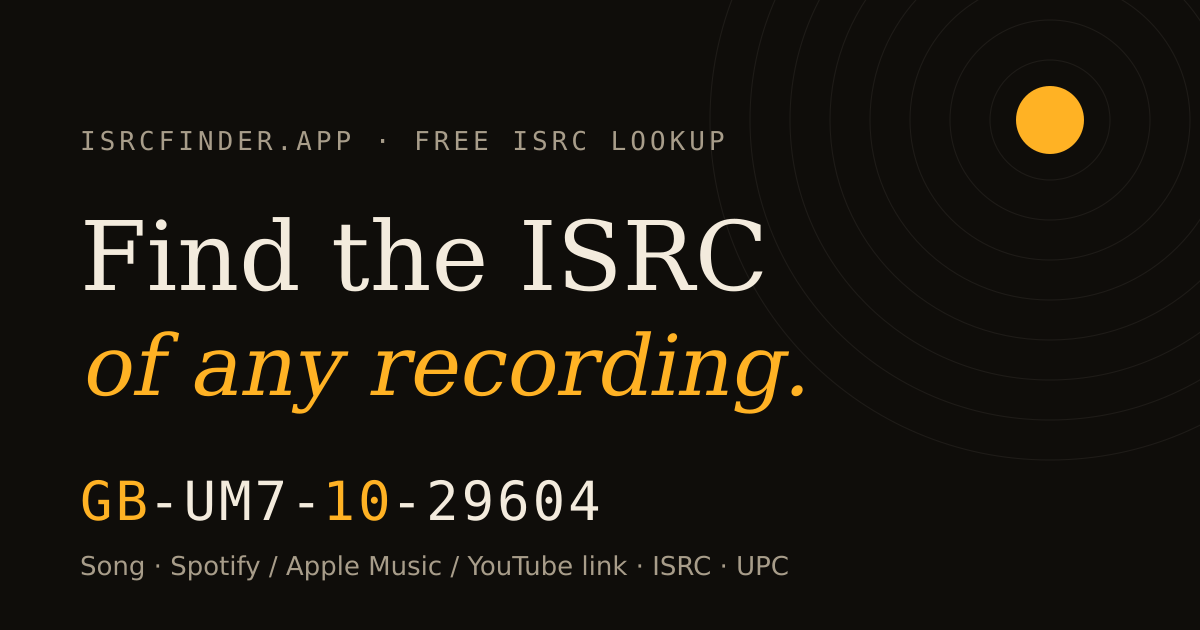
An ISRC has 12 alphanumeric characters, often displayed with hyphens. Take GB-UM7-10-29604:
- GB — the agency prefix, historically the country code of the issuing national agency.
- UM7 — the registrant code, here belonging to a Universal Music entity.
- 10 — the year of reference, 2010, when the code was assigned.
- 29604 — the designation code, a number the registrant gives to this specific recording.
What gets a new ISRC
Every distinct recording needs its own code. A new mix, a remaster that changes the audio, a radio edit, an extended version, a live recording, an acoustic take and a re-recording are all separate recordings. A music video of the song gets its own ISRC too.
Re-releasing the exact same audio, on a compilation, deluxe edition or in another territory, should keep the original ISRC. Reusing codes correctly keeps your streaming history and royalties attached to one recording.
ISRC vs UPC vs ISWC
An ISRC identifies a recording. A UPC (Universal Product Code) or EAN barcode identifies a release, a product such as a single, EP or album, so an album with ten tracks has one UPC and ten ISRCs. An ISWC (International Standard Musical Work Code) identifies the composition itself, the melody and lyrics, and is used for publishing and songwriter royalties. A cover version shares the original song's ISWC but has its own ISRC.
How to get ISRC codes
Most independent artists never apply for codes directly. Distributors such as DistroKid, TuneCore, CD Baby, Amuse or United Masters assign an ISRC automatically, usually free, when you upload a release. The catch is that the registrant code then belongs to the distributor.
Labels and prolific self-releasing artists can become registrants themselves through their national ISRC agency. In the United States that is done through the RIAA's US ISRC agency; other countries have their own agency, often run by a recording industry association. Once you have a registrant code you assign the remaining digits yourself and keep a register of every code you issue.
Why ISRCs matter for royalties
Streaming services report plays by ISRC. Neighbouring-rights societies such as SoundExchange and PPL match broadcast and public performance data to ISRCs. Content ID systems and sync licensing platforms rely on them. A missing or duplicated code can send money to the wrong recording or leave it unclaimed, which is why checking codes before release day is worth a few minutes.
How to find the ISRC of a song
If it is your release, your distributor dashboard lists the code for every track. For any other song, use the ISRC finder on this page: type the title and artist or paste a streaming link and it returns the code from public catalogs, cross-checked with MusicBrainz. You can also reverse the process and paste an ISRC to see which recording it identifies.
Common ISRC code myths
- Myth: the ISRC proves you own the copyright. Fact: it only identifies the recording; ownership is shown by contracts and registrations.
- Myth: each store needs a different ISRC. Fact: one ISRC per recording is delivered to every store and service.
- Myth: the country prefix shows where the song was recorded. Fact: it shows which agency issued the registrant code.
- Myth: an ISRC can be reused after a song is deleted. Fact: codes are never reassigned to another recording.
Where to find the ISRC of your own release
Distributor dashboards show the code next to each track, usually under release details or metadata. Spotify for Artists and Apple Music for Artists do not always display it, so the distributor is the reliable source. Labels keep an ISRC register, often a spreadsheet, that lists every code with title, version, duration and release. If you cannot find a code anywhere, search the released track here: if the store has it, the ISRC finder will show it.
Keep your own copy of every ISRC you receive. Switching distributors, registering with a neighbouring-rights society or licensing a song for film all go faster when the codes are already at hand.
Sources & references
- International ISRC Agency (IFPI) – the ISRC standard and handbook
- US ISRC Agency (RIAA) – registrant codes in the United States
- MusicBrainz ISRC documentation – the open data used for cross-checks
- Deezer API – catalog data for tracks and albums
- GS1 EAN/UPC barcodes – how UPC and EAN numbers work
03 / FAQ
What is an ISRC code? FAQ
What is an ISRC code?
An ISRC (International Standard Recording Code) is a unique 12-character identifier for a single sound or music video recording, defined by ISO 3901 and used to track sales, streams and royalties.
What does an ISRC look like?
For example GBUM71029604, often displayed as GB-UM7-10-29604: agency prefix (2), registrant code (3), year of reference (2) and designation code (5).
Do I need an ISRC for streaming?
Yes. Spotify, Apple Music and other services require an ISRC for every track. Distributors usually assign one automatically if you do not have your own.
Is an ISRC the same as a UPC?
No. An ISRC identifies one recording; a UPC or EAN barcode identifies a release such as an album or single that can contain several recordings.
Does a remix need a new ISRC?
Yes. Any new version with different audio, including remixes, edits, remasters and live recordings, needs its own ISRC.
Can I change an ISRC?
An ISRC should never be reassigned to a different recording. If a wrong code was delivered, the registrant must correct the metadata with stores and distributors.
How much does an ISRC cost?
Many distributors include ISRCs at no extra cost. Becoming a registrant through a national agency may involve a one-time fee depending on the country.
How can I find a song's ISRC?
Use an ISRC finder: search by title and artist or paste a Spotify, Apple Music or YouTube Music link, and the tool returns the code from public catalogs.